This is the final article in our series examining the reforms to the Environment Protection and Biodiversity Conservation Act 1999 (Cth) (EPBC Act). These reforms are being implemented through the Environment Protection Reform Act 2025 (Reform Act), which passed both Houses of Parliament on 28 November 2025 and received Royal Assent on 1 December 2025. The main substantive changes are expected to come into effect on 1 July 2026.
In this article, we focus on the transitional provisions under the Reform Act.
The Reform Act represents the most significant overhaul of Australia's environmental protection framework in a generation. For project proponents, the critical question is not just what changes, but if and when those changes apply to your project.
The Reform Act staggers the application of substantive tests by referral and decision timing, grandfathers many pre-commencement assessment choices, and introduces new greenhouse gas, standards-consistency, unacceptable-impact, and net-gain obligations mainly for post-commencement matters. Legacy exemptions remain valid but become subject to parts of the new framework.
This Insight refers to key concepts and reforms which are explored in detail through our EPBC Act Reforms – What You Need to Know series.
The transitional arrangements under the Reform Act establish three distinct pathways that determine when the EPBC Act reforms will apply to your project, depending on its stage. These three categories are referred projects, projects in the assessment pipeline, and approved projects. Each pathway carries different obligations and protections. Understanding which pathway applies to your project is essential for strategic planning and risk management.
This article provides a comprehensive guide to navigating the transition, with practical guidance on timing, compliance obligations, and strategic considerations.
Timing considerations
Transitional provisions manage the gap between the old and new legislation. A key point in the transitional is the day on which the legislation or part of the legislation commences or put another way becomes legally effective.
The Reform Act defines 'commencement day' as either:
- the day the amendment or provision commences; or
- if a notifiable instrument specifies that the amendment or provision applies in relation to a matter or thing on a different day (the application day), the application day to the extent that the amendment or provision applies to the matter or thing.
The main substantive amendments are expected to come into effect on 1 July 2026. The transitional provisions will commence following Royal Assent. The Minister may provide by notifiable instrument that amendments apply on different days for different matters or things.
This approach allows for staged implementation, meaning there is not a single 'commencement day' for all purposes. Different provisions commence at different times, and the Minister may specify different application days for different matters. When assessing whether your project benefits from transitional protections, you need to identify which specific provisions are relevant and when those provisions commence or apply to your particular circumstances.
The three categories explained
The transitional arrangements divide projects into three broad categories based on their status at commencement. Each category receives different treatment under the reforms.
Category 1: Projects not yet referred
These are projects that have not been referred to the Minister under sections 68, 69 or 71 of the EPBC Act before the commencement day of the Reform Act. For these projects, the new Part 12A bioregional planning framework applies to actions started on or after commencement. The amended assessment provisions, including streamlined assessment, apply from commencement. For projects referred on or after commencement, new mandatory decision tests apply, including:
- consistency with national environmental standards;
- no unacceptable impact; and
- net gain requirements for residual significant impacts.
For detailed look into the reforms to the assessment and approvals process, see our earlier insight on the revised approvals framework here.
Category 2: Projects in the assessment pipeline
This category includes projects referred before commencement where either:
- the Minister has not yet decided whether the action is a controlled action; or
- the Minister has decided it is a controlled action but has not yet approved it under section 133 of the EPBC Act.
Part 12A (Bioregional plans) does not apply to actions referred pre-commencement where a controlled-action or approval decision was still pending at commencement. The new Part 12A bioregional planning framework applies only to actions started on or after the commencement day and does not apply to actions referred pre-commencement where a controlled-action or approval decision was still pending at commencement. This creates significant advantages for projects already in the assessment pipeline. This is the most significant protection for projects in the pipeline.
If the Minister chose an assessment approach before commencement, the replacement of approaches with streamlined assessment generally does not re-open that choice. However, otherwise, the amended assessment provisions apply from commencement, including to pre-commencement referrals.
Category 3: Approved projects and commenced actions
This category includes projects with existing approvals under Part 9, strategic assessment approvals under section 146B, national interest exemptions, and actions that have already commenced.
Part 12A (Bioregional plans) applies only to actions started on or after commencement, meaning if you have started an action before commencement, the action will continue under the former EPBC Act. New and amended strategic assessment tools apply to section 146B approvals whether given before or after commencement, but the approvals themselves remain valid.
Other project categories
The transitional arrangements for projects that fall outside the above categories are explained as follows.
Projects that have received a 'not a controlled action' or 'particular manner' decision
This category covers projects that have received a decision from the Minister that the proposed action:
- is not a controlled action under section 75 of the EPBC Act; and
- is not a controlled action if taken in a particular manner under section 77A of the EPBC Act.
The Minister retains the discretion to decide whether an action is a controlled action or that an action must be taken in a particular matter. However, decisions made after commencement will expire 5 years after notice of the decision is given if the action has not been 'substantially commenced'. The Minister may extend a 'not a controlled action' decision past 5 years and up to a maximum of 10 years.
Projects with prior authorisation or the continuation of use exemption
Actions with prior authorisation under section 43A of the EPBC Act will continue to be exempt from EPBC approval.
The continuation of use exemption under section 43A of the EPBC Act will continue to apply to actions which have occurred before the commencement of the EPBC Act on 16 July 2000. However, in addition to existing exceptions to this exemption, this exemption will no longer apply to an action which:
- involves clearing vegetation from land where the land has not been cleared of vegetation for at least 15 years and the action is not a forestry operation; and
- involves clearing vegetation (regardless of age of vegetation) within 50m of a watercourse, a wetland or a drainage line in the Greater Barrier Reef catchment area
EPBC Act approval will be required for activities that fall into the above categories.
See our earlier insight for a detailed look into the reforms to the legacy exemptions (43A and 43B).
Projects that have not previously triggered referral
For projects that have not previously required referral under the EPBC Act, there are changes to the scope of the nuclear action trigger which do not attract the benefit of transitional provisions. The 'nuclear action' trigger is changed to 'radiological exposure’ and there are new controlling provisions. As transitional provisions do not apply to these actions, referral may be required of activities that fall within the new controlling provisions whether or not the activities have been undertaken before or after commencement.
Where does your project sit?
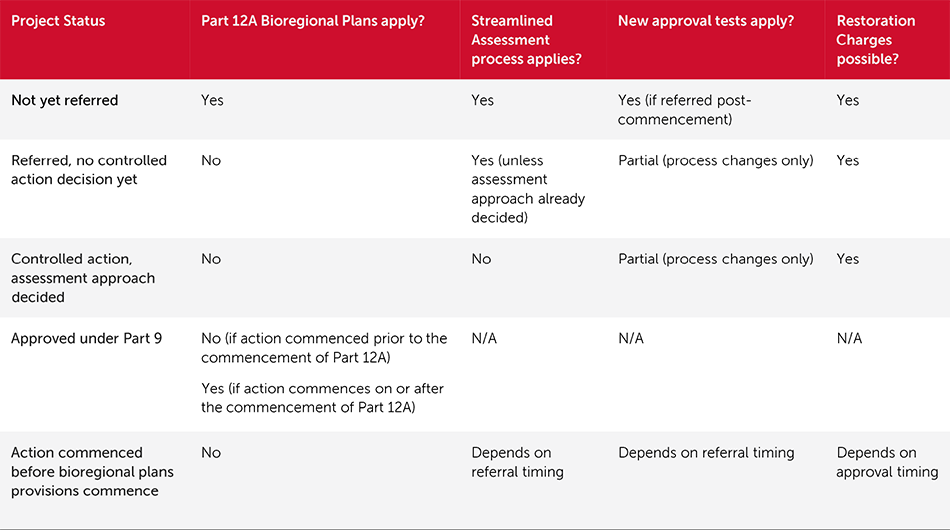
The table below summarises how the reformed EPBC Act framework applies to projects at different stages of the approval process. It sets out the key regulatory changes, including bioregional plans, streamlined assessment processes, new approval tests and restoration charges, and identifies which exemptions or grandfathering provisions may be available depending on a project's status at the time the reforms commence.
Category specific transitional arrangements
Projects not yet referred: preparing for the new framework
Projects not yet referred will be subject to the full suite of reforms. See our other articles in the EPBC Act Reforms – What You Need to Know series to learn about bioregional planning requirements, the enhanced approval tests and the streamlined assessment pathway.
Projects in the pipeline: your transitional protections
What's protected?
Projects already referred but not yet decided, receive significant transitional protections, including:
This means projects referred before commencement are not subject to the new substantive approval tests, even if the approval decision is made after commencement.
What still changes?
Not everything is protected. The following provisions apply even to pre-commencement referrals:
- Process-Oriented Amendments: Process-oriented amendments (for example, for condition variations, suspension, revocation, transfer, extension) apply to decisions on or after commencement regardless of referral or approval date. New surrender of approval provision applies to approvals whether given before, on or after commencement.
- Restoration Contribution Charges: Charge-related approval and condition powers apply to decisions made on or after commencement, even if the referral was earlier. This means even projects with pre-commencement referrals may be subject to restoration contribution charges if the approval decision is made after commencement.
- Information and Reporting: Amended information-gathering and procedural provisions apply to decisions irrespective of referral timing. Updated content requirements for recommendation reports apply to reports given on or after commencement, even if prepared earlier.
- Streamlined Assessment (if no assessment approach has been determined): If the Minister has not determined an assessment approach before commencement, the amended assessment provisions apply from commencement, including to pre-commencement referrals. The new power to change assessment approach applies to referrals made on or after commencement.
Strategic considerations
For projects in the pipeline, the key strategic considerations are:
- Securing assessment approach decisions: If the Minister determined an assessment approach before commencement, the replacement of approaches with streamlined assessment generally does not re-open that choice. If your project has been referred but no assessment approach has been decided, consider whether it is advantageous to secure that decision before commencement to lock in the existing framework.
- Managing restoration contribution charges: Even projects with pre-commencement referrals may face restoration contribution charges. General restoration actions must deliver net gain for the same protected matter in the affected bioregion where possible; combination and pooling rules aim for better environmental outcomes across multiple impacts. Consider how to address potential charge obligations in your project planning and financing.
- Leveraging Part 12A exemption: The exemption from Part 12A is a significant advantage. For projects in regions likely to receive bioregional plans with restrictive conservation zones, this exemption may be the difference between project viability and prohibition.
- Monitoring procedural changes: Process-oriented amendments apply regardless of referral date. Stay informed about new procedural requirements for condition variations, transfers, and other approval modifications.
Approved projects: maintaining compliance
What stays the same?
Projects with existing approvals receive strong protections:
- Approval validity: Existing approvals under Part 9 remain valid and are not invalidated by the reforms. New and amended strategic assessment tools apply to section 146B approvals whether given before or after commencement, but the approvals themselves continue in effect.
- Exemption from Bioregional Plan restrictions: Comprehensive transitional protections ensure new or changed zones and actions do not retrospectively bind commenced or referred actions. Part 12A applies only to actions started on or after commencement, meaning approved and commenced actions are not subject to new restrictions on actions in conservation zones or requirements to register priority actions.
- National Interest Exemptions: Despite repeal of section 158, pre-commencement section 158 exemptions continue, the old section 158 continues to govern those exemptions. Equivalent continuity applies for pre-commencement Part 13 section 303A exemptions.
New compliance obligations
Whilst approvals remain valid, new compliance and enforcement tools will apply:
- Enhanced audit powers: New directed environmental audit regime (Part 17 Division 12) applies to authorities, orders, exemptions (and certain marine permissions) made before, on or after commencement, and to conduct before, on or after commencement. However, if an audit notice was issued before commencement and the report wasn't yet lodged, the pre-amendment regime continues for that audit.
- Environment protection orders: New environment protection order powers (Part 17 Division 13A) apply to environmental authorities made before, on or after commencement. The triggering contraventions can have occurred before, on or after commencement.
- Strategic assessment compliance: Approvals under section 146B can be varied to align with variations to endorsed policies, plans or programmes (including adjusting actions, classes, persons, or conditions). Mandatory consultation, notification, effect and timing rules apply, plus a targeted power to apply variations to substantially commenced actions following a brief hearing-rule code.
- Surrender and information requests: New surrender of approval provision applies to approvals whether given before, on or after commencement. New Division 3 of Part 11 applies to actions regardless of whether taking started before or after commencement; surrender and information request powers also apply to pre-commencement section 158 exemptions.
Updated annual reporting duties apply to Public Governance, Performance and Accountability Act 2013 (Cth) annual reports and section 97 documents given on or after commencement. New information-handling framework (Part 20B) applies to information whether obtained or generated before, on or after commencement.
Public registers, annual reporting, and a Special Account ensure transparency and accountability for restoration contributions and environmental outcomes.
Action steps
For approved projects, the focus should be on:
- Compliance system review: Review your environmental management systems to ensure they can demonstrate compliance with approval conditions and respond to the new audit and enforcement powers.
- Documentation and record-keeping: The new directed environmental audit regime applies to conduct before, on or after commencement. Ensure comprehensive documentation of compliance with approval conditions, even for past conduct.
- Strategic assessment monitoring: If your approval is under section 146B, monitor for variations to endorsed policies, plans or programmes that may trigger variation of your approval.
- Reporting preparation: Prepare for updated annual reporting duties and new information-handling requirements.
'Not a controlled action' or 'particular manner' decisions
For projects that receive a 'not a controlled action' or 'particular manner' decision after commencement, plan for 'substantial' commencement of the action within 5 years of the decision.
Strategic planning: what to do now
The grid below illustrates the four key project stages and the corresponding strategic considerations that arise during the transition to the reformed EPBC Act framework. For each stage, proponents must carefully weigh timing decisions, assess the benefits of grandfathering provisions against the risks of delay, and prepare for new compliance obligations under the reformed EPBC Act.
Projects not yet referred
- Consider whether referring before commencement would secure Part 12A exemption.
- Balance this against referral readiness and risk of adverse decision under existing framework.
- Monitor draft bioregional plans to understand likely zone classifications.
Projects referred but no assessment approach determined
- Consider seeking an assessment approach decision before commencement to lock in the existing framework.
- Weigh benefits of grandfathering against potential delays in the assessment process.
Projects with assessment approach determined
- Proceed with confidence that the chosen assessment pathway is protected under the existing framework.
- Prepare for potential restoration contribution charges in the approval decision.
Approved Projects
- Focus on compliance and documentation of conditions.
- No immediate timing urgency, but be prepared for enhanced audit and enforcement powers in the future.
These considerations are explored in further detail below.
For projects not yet referred
- Conduct bioregional plan assessment: Understand whether your project is likely to fall within a conservation zone (where restricted actions are prohibited) or development zone (where priority actions must be registered), and plan accordingly. Taking a restricted action in a conservation zone is an offence and may attract civil penalties unless an approval, exemption or other exception applies. Projects in conservation zones may face prohibition or require exceptional circumstances exemptions.
- Prepare for enhanced approval tests: Ensure your environmental impact assessment addresses consistency with national environmental standards, avoidance of unacceptable impacts, and net gain for residual significant impacts. The requirement to avoid unacceptable impacts, with limited exceptions, may result in refusal of approval for projects that would have been approved under the existing framework.
- Compile greenhouse gas information: Prepare prescribed Scope 1 and Scope 2 greenhouse gas information for inclusion in referral and assessment documentation.
- Consider timing of referral: Analyse whether referring before commencement would secure valuable transitional protections, particularly Part 12A exemption.
- Engage early: Consult with the Department, relevant State/Territory agencies, and environmental consultants to understand how the new framework applies to your specific project.
- Plan for 'controlled action' and 'particular manner' decisions to expire: If your project received a 'no controlled action' decision, understand and plan for that decision to expire 5 years after you receive notice of the decision. There is the ability for the decision to be extended, however, this will be at the discretion of the Minister.
For projects in the assessment pipeline
- Leverage Part 12A exemption: Understand and communicate to stakeholders that your project is exempt from bioregional plan restrictions.
- Secure assessment approach decision (if not yet decided): If the Minister has not yet chosen an assessment approach, consider whether securing that decision before commencement would be advantageous.
- Plan for restoration contribution charges: Even projects with pre-commencement referrals may face restoration contribution charges if approval is granted after commencement. Understand how general restoration actions must deliver net gain and how combination and pooling rules work.
- Monitor procedural changes: Stay informed about new procedural requirements for condition variations, transfers, and other approval modifications.
- Maintain assessment momentum: Continue progressing your assessment to secure approval whilst transitional protections apply.
For approved projects
- Review compliance systems: Ensure your environmental management systems can demonstrate compliance with approval conditions and respond to new audit and environment protection order powers.
- Strengthen documentation: The new directed environmental audit regime applies to conduct before, on or after commencement. Ensure comprehensive records of compliance.
- Monitor strategic assessment variations: If your approval is under section 146B, monitor for variations to endorsed policies, plans or programmes.
- Prepare for enhanced reporting: Update systems to comply with updated annual reporting duties and new information-handling requirements
- Consider voluntary improvements: The new framework emphasises transparency and net gain outcomes. Consider whether voluntary environmental improvements could enhance your social licence and regulatory relationships.
For Projects with the continuation of use exemption
- Check the scope of the exemption: Ensure that new activities fall within the continuation of use exemption in section 43B. For activities that fall outside the exemption, EPBC approval may be required.
- Review the scope of the trigger: Reassess whether activities require referral under the scope of the new 'radiological exposure’ which replaces and expands the 'nuclear actions trigger.
Watch this space
- Will my existing Part 9 approval remain valid after commencement? Yes. Existing approvals under Part 9 remain valid and are not invalidated by the reforms. However, new audit and environment protection order powers apply to approved projects, and to conduct before, on or after commencement.
- If I refer my project before commencement but the approval decision is made after commencement, which framework applies? Part 12A (Bioregional plans) does not apply to actions referred pre-commencement where a controlled-action or approval decision is still pending at commencement. New mandatory decision tests apply to Part 9 decisions made on or after commencement only if the referral was made on or after commencement. Restoration contribution charge powers apply to decisions made on or after commencement, even if the referral was earlier.
- What happens if a bioregional plan is made after I commence my action? Comprehensive transitional protections ensure new or changed zones and actions do not retrospectively bind commenced or referred actions. Part 12A (Bioregional plans) applies only to actions started on or after commencement. If you commenced your action before the bioregional plan came into effect, you are not subject to restrictions on actions in conservation zones or requirements to register priority actions.
- Can the Minister still grant a national interest exemption under the new framework? Section 158 of the EPBC Act allows the Minister to exempt some actions from certain requirements under the EPBC Act where the exemption is in the national interest. The Reform Act repeals section 158. However, exemptions granted under section 158 before commencement will remain valid, and the old section 158 will continue to govern those exemptions. The Reform Act introduces new Division 3 of Part 11 which contains a new national interest exemption which, if approved, will apply to actions regardless of whether the action started before or after commencement. The Minister may also grant exemptions from restricted-action prohibitions on exceptional circumstances or national interest grounds, with structured consultation, publication, confidentiality limits, and emergency pathways.
- What are restoration contribution charges and when do they apply? The Minister may require a proponent to pay restoration contribution charges as a condition of approval where the approved action will have a residual significant impact on an MNES.Restoration contribution charges may be imposed instead of or in addition to requiring offsets and can only be imposed with the consent of the proponent. Restoration contribution charges are to be paid into a new Restoration Contributions Special Account which will use funds to deliver net gain for the same protected matter in the affected bioregion where possible. Combination and pooling rules aim for better environmental outcomes across multiple impacts. Charge-related approval and condition powers apply to decisions made on or after commencement, even if the referral was earlier.
- If my project's assessment approach was decided before commencement, will the project be subject to streamlined assessment? No. The new streamlined assessment approaches will not apply to projects where an assessment approach has already been determined under the EPBC Act before commencement of the Reform Act, except where specific exemptions apply. Therefore, If the Minister chose an assessment approach before the commencement date, your project's assessment will continue under the existing EPBC Act framework.
- Do the new greenhouse gas information requirements apply to my project? Revised greenhouse gas information requirements apply to actions referred on or after commencement. If your project was referred before commencement, the new requirements do not apply (though existing greenhouse gas information requirements under the current framework may still apply).
- Can my strategic assessment approval be varied after commencement? Yes. Approvals under section 146B of the EPBC Act can be varied to align with variations to endorsed policies, plans or programmes (including adjusting actions, classes, persons, or conditions). Mandatory consultation, notification, effect and timing rules apply, plus a targeted power to apply variations to substantially commenced actions following a brief hearing-rule code.
- Will the Minister make additional transitional rules? Possibly. The Minister may make legislative instruments dealing with transitional matters for these reforms and related Acts. Any modification rules for the transitional provisions in Part 3 of Schedule 1 or Division 3 of Part 3 of Schedule 2 of the Reform Act must be made within 12 months of commencement. Those rules cannot create offences or civil penalties, confer coercive powers, impose taxes, appropriate funds, or directly amend the Acts.
Proponents should:
1. Review project timelines: Assess whether adjusting project timelines to secure transitional protections would be advantageous.
2. Engage with bioregional planning: Participate in public consultation on draft bioregional plans to understand and influence zone classifications and priority action definitions. For a deeper dive into the reforms to bioregional planning, see our earlier insight on the revised approvals framework here.
3. Seek expert advice: The transitional arrangements are complex and project specific. Early legal and environmental advice is essential for understanding how the reforms apply to your specific circumstances.
4. Watch for transitional instruments: Monitor for additional transitional rules that the Minister may make within 12 months of commencement.
The Reform Act will reshape environmental regulation in Australia for decades to come. Proponents who understand the transitional arrangements and plan strategically will be best positioned to navigate the reforms successfully and maintain project momentum through the transition.